Will Boomers Selling Flood the Housing Market? What 13.9 Million Homes Means for La Quinta and Palm Desert
If you are in your sixties in a desert house and you have been waiting for the right moment to sell, you have probably seen the headline by now. Something like a silver tsunami, or thirteen point nine million homes about to hit the market. It is a real number from a real analysis. It is also being read backwards by almost everybody who repeats it, and if you own here, reading it backwards could cost you a year.
Here is what the number actually says.
The number
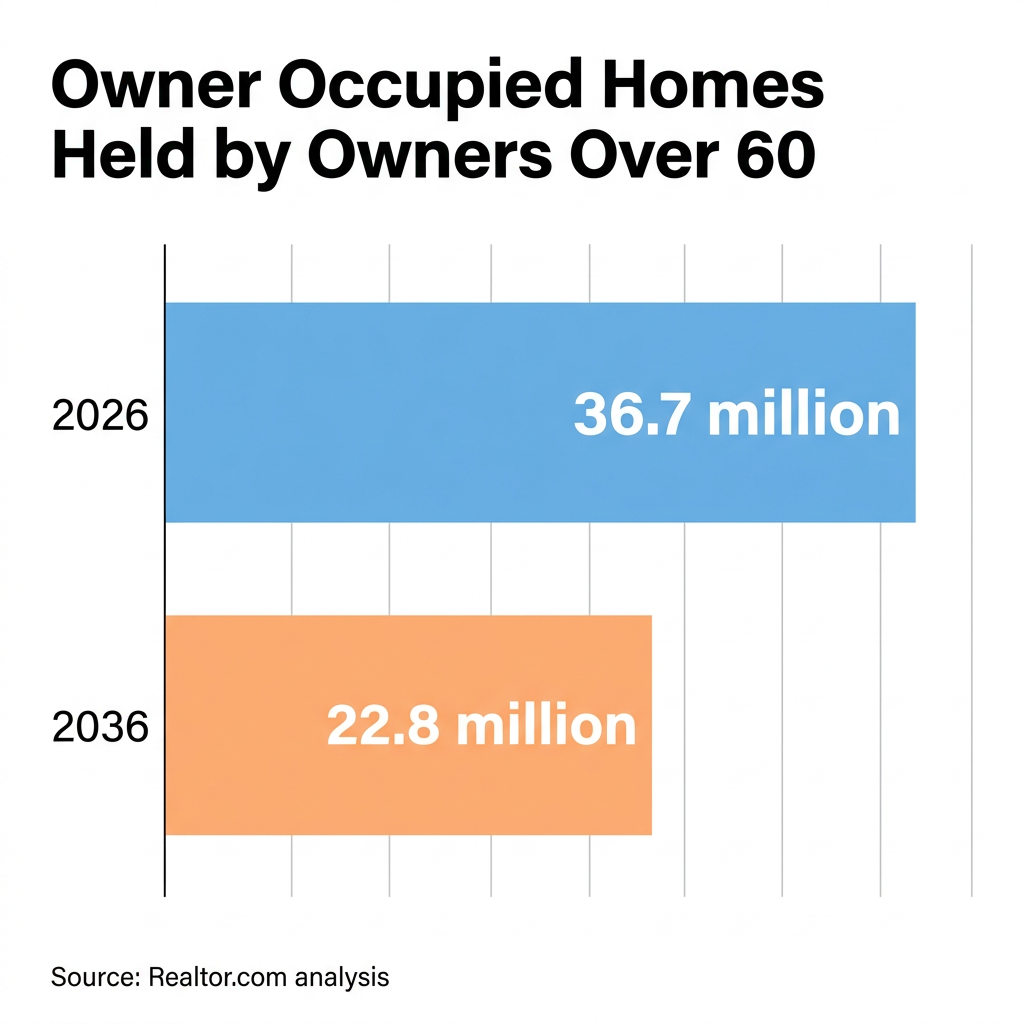 A Realtor.com analysis, written up by HousingWire and circulated through the C.A.R. Market Matters email, projects that owner occupied homes held by baby boomers and the Silent Generation will fall from 36.7 million in 2026 to 22.8 million by 2036. The difference is 13.9 million homes, which works out to roughly 1.39 million a year. The pace builds, from about 1.27 million in 2027 to about 1.52 million by 2036. Compared with the prior decade's roughly 8 million, that is an increase of about 34 percent.
For context, the country is short roughly 4 million homes. Harvard's Joint Center for Housing Studies projects about 859,000 new households a year, against the 1.2 million a year the country has averaged since 2000. So the release is large, and it is landing into a shortage rather than into a glut.
What the analysis does not say, and this is the part that matters
It names no states and no metros. And it says turnover is fastest in the Rust Belt and the Midwest, not in expensive coastal markets.
So nobody should be telling you that 13.9 million homes are coming to the Coachella Valley. The honest local version is close to the opposite, and I think it is more interesting. This valley is not waiting for the wave. It is the place that already got it.
California crossed the line in 2024 where residents 60 and over began outnumbering children under 18, and the state projects about 28 percent of Californians will be 60 or older by 2040. That is the California Department of Aging's own figure. The desert passed that mark well before the state did. If you want to know what a market looks like after the demographic shift arrives, you can look out the window.
Which homes are actually being released
This is the detail that got buried, and it is the one that changes what you do.
 The release is overwhelmingly big houses. Three and four bedroom family homes are 9.9 million of the 13.9 million, which is 71.2 percent, close to a million a year on their own. Five bedroom and larger homes add another 3.6 million.
Starter homes, meaning zero to two bedrooms, are only 0.38 million of it. About 38,000 a year. That is 3.2 percent of Realtor.com's current annual listing volume. Boomer and Silent Generation owners hold about 1.33 million starter homes, which is 51.3 percent of that whole segment, and they are barely letting go of them.
Read those two facts next to each other and the picture inverts. The homes being released are the ones people are leaving. The homes people are moving into are not being released.
If you are selling a four bedroom here and buying something smaller and single level in the same five miles, the national data says you are selling into more competition and buying into less. Not more. Less.
What this means if you own here
Four things, and none of them is urgent in the way a headline wants it to be.
First, do not time a sale around a national wave that the data says is not aimed at you. Turnover is fastest where houses are cheap and people leave. That is not this valley.
Second, if the plan is to sell the big house and buy the smaller one, the smaller one is the harder half. Single level floor plans here are already in short supply, and the analysis says that stock is the least likely to free up. Line up where you are going before you decide when you are leaving.
Third, if the plan is to sell the big house and leave the valley entirely, more competition from similar homes over the next decade is worth knowing about. It is a reason to be realistic about condition and price, not a reason to rush.
Fourth, nothing in this report tells you anything about your street. A national projection is a weather forecast for a continent.
What I do not know yet, and I looked
There are three valley specific questions this report cannot answer, and I would rather say so than fill them in:
How much of our current inventory is actually a 55 plus listing or an estate sale, rather than an ordinary move.
What a three or four bedroom family home does on days on market here against a smaller single level home.
Whether the single level and 55 plus stock people are trying to buy is the same stock that is not being released, which is what the national split implies but does not prove locally.
All three need our own MLS numbers rather than a national study. I can pull them. If you want the version of this with Coachella Valley figures in it instead of national ones, ask me and I will run it for your community specifically.
The short version
A lot of houses are coming, mostly big ones, mostly somewhere else, over ten years. The desert got its version of this early. The squeeze here is not going to be finding a buyer for the big house. It is going to be finding the smaller house you actually want.
Everything on the blog is open. No form, no email, nothing to sign up for.
My Take: I would not plan anything around a ten year national projection. I would plan it around whether your own house still fits you.
Laura Lake | Your Desert Real Estate Partner | DRE #01455311
Categories
Recent Posts

GET MORE INFORMATION