
Should You Wait for Lower Interest Rates to Buy in the Coachella Valley? What Waiting Since 2023 Actually Cost
At the end of December 2023, the average 30-year fixed mortgage was 6.61%.
Almost every buyer I spoke with that winter said the same thing. Rates had just touched 7.79% in October, the highest in 23 years, and everyone expected them to fall. So they waited.
This morning, the 30-year fixed is 6.95% to 7.26%.
That is the whole problem with waiting for rates, in one comparison. Not a prediction, not an opinion. The people who decided to wait at the end of 2023 are looking at a higher rate today than the one they turned down.
I want to walk through what that actually cost, using real Coachella Valley numbers. And I want to separate two things that keep getting mixed together in conversations: a price reduction, and a drop in value. Those are not the same event, and confusing them is leading people to make an expensive decision.
First, the thing everyone is getting wrong
When you see a price reduction on a listing, that tells you one thing: the seller listed above what a buyer was willing to pay.
That is a pricing event. It happens in hot markets and cold ones. It is a statement about one seller's expectations, not about what homes are worth.
A drop in value is different. That means the asset itself is worth less than it was before. And here is the standard I hold that to: for home values in the Coachella Valley to actually be declining in a way that matters, we would have to fall back below where we were before the pandemic distorted everything.
We are nowhere close.
The numbers, 2019 to today
I pulled the local housing reports going back to 2018 so I could see the whole arc rather than one month of it.
| Year end | Detached median | Active listings | Sales pace, per month |
|---|---|---|---|
| 2018 | $387,000 | 3,555 | 845 |
| 2019 | $415,000 | 3,187 | 800 |
| 2020 | $520,000 | 1,507 | 910 |
| 2021 | $615,000 | 607 | 1,016 |
| 2022 | $640,000 | 1,911 | 715 |
| 2023 | $659,000 | 2,139 | 606 |
| 2024 | $665,000 | 2,898 | 607 |
| 2025 | $660,000 | 3,028 | 623 |
| July 2026 | $650,000 | 2,668 | 626 |
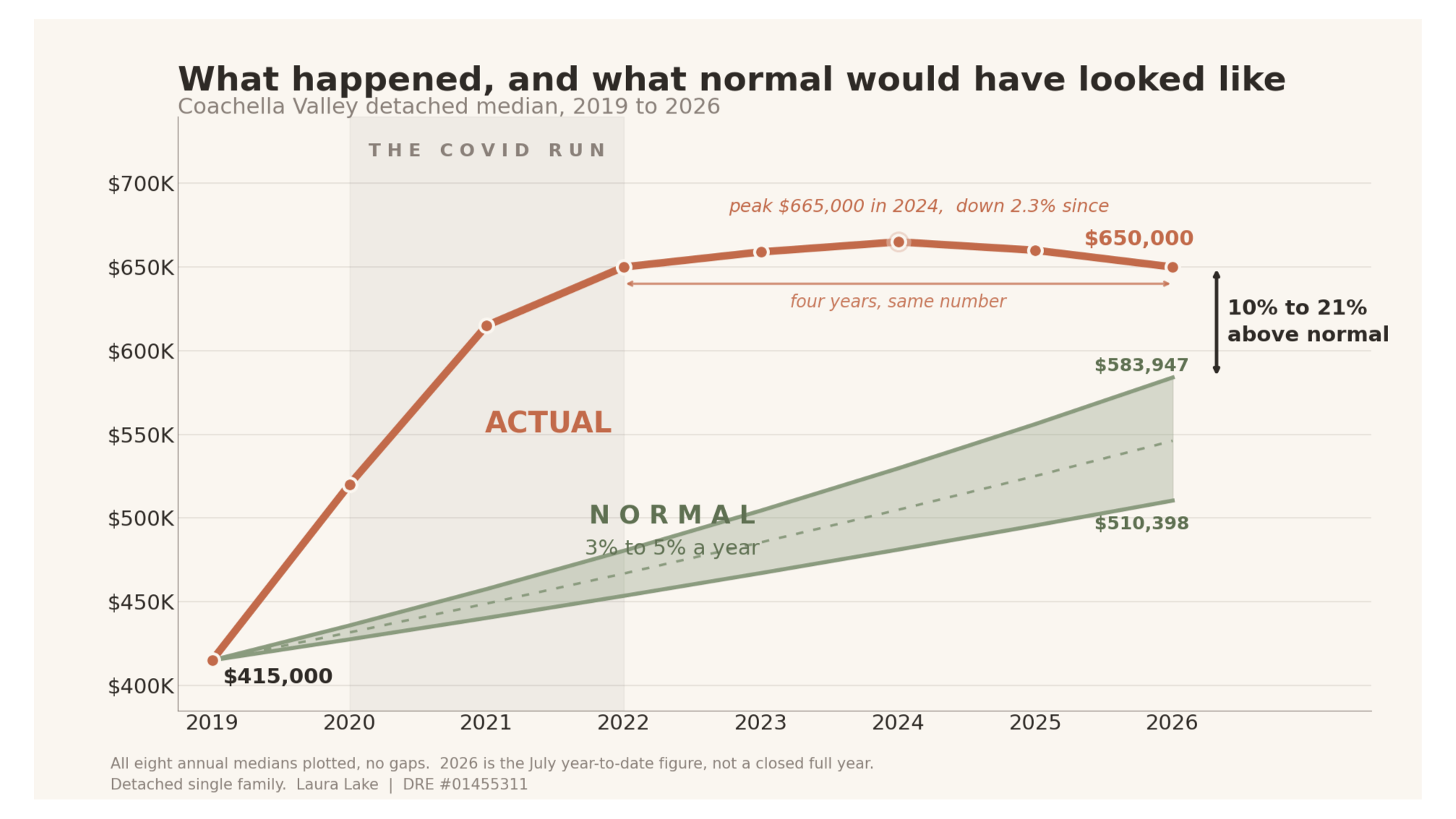
The detached median was $415,000 at the end of 2019. It is $650,000 in the most recent report.
That is roughly 57% higher than before the pandemic.
So when someone tells you Coachella Valley home values are dropping, here is the question worth asking: dropping from what? From the 2022 peak, yes, in most cities. From 2019, not remotely. A home here would need to lose about 36% of its current value to erase the gains of the last six years.
I am not predicting that. I am telling you what the word "dropping" would actually have to mean.
 What the COVID years really did
This is the part I think explains everything else.
A healthy, sustainable rate of home appreciation is somewhere between 3% and 5% a year. That is the pace wages and rents can keep up with.
Here is what we actually got:
- 2019: +4%
- 2020: +10%
- 2021: +19%
- 2022: +6%
- 2023: +5.5%
- 2024: +4.2%
- 2025: +1.4%
- 2026: tracking around +1.5%
Look at 2021. Nineteen percent in a single year, against a normal range of 3% to 5%. That was not the market working. That was a distortion, and some of it was always going to come back out.
Which is exactly what the last three years have been. 2024 came in at 4.2%, back inside the normal band. 2025 was 1.4%. This year looks similar. The market is not falling apart. It is decompressing, slowly, from an inflated peak.
And this is why I think it takes another four to five years to fully work off. Wages are expected to rise around 3% a year while home prices stay roughly flat. Do that for long enough and housing quietly becomes about 20% more affordable without a single dramatic headline. That is what a healthy correction looks like. It is boring, and it takes time.
What it would actually take for values to fall
There are three things a real housing crash needs. Not one. All three.
1. A glut of homes for sale. We do not have it. The Valley had 3,187 active listings at the end of 2019. The most recent report shows 2,668. Inventory is 16% below where it was before the pandemic. It rebuilt from the 2021 shortage of 607 homes, and then stopped short of normal.
2. A wave of distressed sellers. This one deserves honesty rather than a talking point. Foreclosure filings nationally rose 21% in the first half of 2026 and hit a six-year high. That is real and I am not going to wave it away. But it is still running below pre-pandemic levels, and it is nowhere near the 2008 era. The reason matters: after six years of appreciation, most owners in trouble have real equity. An owner with equity sells. An owner who is underwater gets foreclosed on. That is the difference between 2026 and 2008, and it is the whole difference.
3. Very low demand. This one we do have. The sales pace is about 22% below 2019. Fewer people are buying.
So: one out of three.
Out of roughly 75 years of American housing, there have been about six downturns. But only twice have home values broadly fallen: the Great Recession, and the savings and loan crisis of the 1980s, which hit California hardest. Both times, all three conditions were present at once. Right now, one is.
Now the part that costs real money
Let us go back to the person who decided to wait at the end of 2023.
| Bought Dec 2023 | Buying today | |
|---|---|---|
| Price | $659,000 | $650,000 |
| Rate | 6.61% | 6.95% |
| Loan at 20% down | $527,200 | $520,000 |
| Monthly principal and interest | $3,370 | $3,442 |
The house got $9,000 cheaper. The money got more expensive. Net result: the payment is about $72 a month higher today than if they had bought back then. Roughly $860 a year, for the same house.
To match the December 2023 payment at today's lower price, you would need a rate of 6.74%. We are at 6.95%.
And that is only one side of it. The person who bought in December 2023 has made 33 payments. About $16,832 of that went to principal, straight into their own equity. Even after the $9,000 dip in the median, they are ahead by roughly $7,800, on top of the down payment they already had.
The person who waited has none of that.
Here is the asymmetry I want you to sit with. If rates fall next year, the 2023 buyer refinances and gets the lower rate anyway. The person who waited does not get 2024 and 2025 back. You can refinance a rate. You cannot refinance time.
If you are waiting for something below 5%
I understand the instinct. If you bought or refinanced in 2020 or 2021, you saw a 3% mortgage and it reset what "normal" felt like.
But that period was the anomaly, not the baseline. And as of this week, the Federal Reserve just raised rates for the first time since 2023, with 16 of 18 committee members expecting at least one more increase this year.
I do not know where rates go. Nobody does, and anyone telling you with confidence is guessing. What I can tell you is that a sub-5% mortgage is not something I would build a life plan around right now.
So what should you actually do
Stop trying to time it. Not because timing is unwise in principle, but because the last three years are a clean, documented example of it not working. Prices did not meaningfully fall. Rates did not fall. The waiting produced neither.
The better question is not "is this the bottom." It is:
- Do I plan to be here at least five years?
- Is the payment comfortable at today's actual rate, not a hoped-for one?
- Do I have reserves after closing?
- Does this house fit the life I am actually living?
If the answer to those is yes, the market timing question mostly takes care of itself. If the answer is no, then no rate makes it the right move, and I will tell you that directly. I have told plenty of people to wait when waiting was right for their situation.
The right time to buy or sell is not a market condition. It is a personal one.
A note on the numbers
The median figures here come from the Greater Palm Springs REALTORS Desert Housing Report and its predecessor reports, using the detached single-family median across the ten-city region. You may see me quote a different figure, around $550,000, in other posts. That one is the all-property-types median, which includes condos and attached homes and runs lower. Both are accurate. They are measuring different things, and I try to say which one I am using every time.
Mortgage rates are Freddie Mac's weekly survey. Payment figures are principal and interest only at 20% down on a 30-year fixed, and they exclude property taxes, insurance, HOA dues and Mello-Roos, which are not small here.
I am a real estate agent, not a lender, a CPA, or a financial advisor. Run your own numbers with the right professional before making a decision this size.
If you want to know what any of this means for your specific house or your specific budget, call or text me at 760-464-8138. I will run the real numbers with you, and if the answer is that you should wait, I will say so.
Laura Lake | Your Desert Real Estate Partner | DRE #01455311 | Brokered by LPT Realty
Categories
Recent Posts


GET MORE INFORMATION