California Prop 37 Explained for Coachella Valley Buyers: 3% Down, But Only on a New Home (2026)
If you have been sitting out because the down payment is the wall, there is a measure on your November ballot built specifically for you. There is also a condition in it that most of the coverage skips, and it changes who this actually helps in the Coachella Valley.
Here is what Proposition 37 does, what it does not do, and what I would check before it changes anything about your plan.
What Prop 37 actually does
Proposition 37 is on the November 3, 2026 California ballot. Its official title is "Creates Loan Program for Middle-Income Buyers of Qualified New Homes."
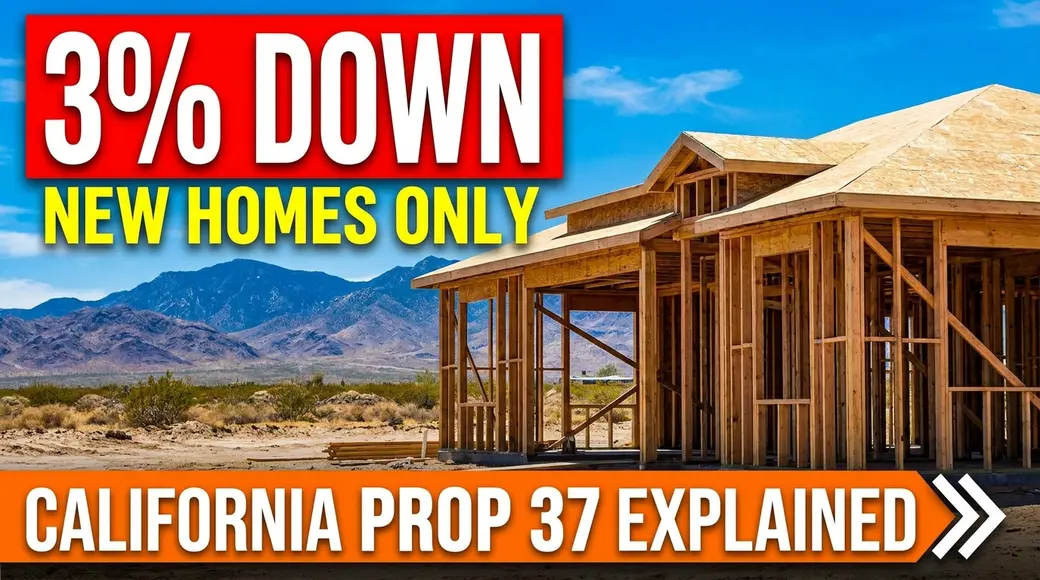
If it passes, the California Housing Finance Agency, CalHFA, could sell up to $25 billion in revenue bonds. It would use that money to fund a second loan, called a middle-class homeownership loan, covering up to 17 percent of a home's price. The buyer brings at least 3 percent.
So the math a buyer sees is 3 percent out of pocket instead of 20 percent, with the program filling the gap.
Two things about the money that matter:
The bonds are revenue bonds, not general obligation bonds. They get repaid out of the payments homeowners make on those loans, not out of the state General Fund. The Legislative Analyst's Office puts the direct state and local cost at zero.
And you still pay it back. This is a loan, not a grant, and it carries a monthly payment. CalHFA would be required to keep the interest cost as low as it can, and the rate has not been set.
The condition most of the coverage leaves out
The loan only works on a newly built home, and you have to be its first purchaser.
That single line does more to decide who this helps than anything else in the measure. A 1978 condo in Palm Desert does not qualify. A resale in La Quinta Cove does not qualify. The overwhelming majority of what sits on the market in this valley on any given day does not qualify.
If you have been picturing this as a way into an existing home with 3 percent down, that is not what is on the ballot.
Who and what would qualify
Beyond the new construction requirement:
- You would need to be a California resident.
- Your household income could not be more than double the typical income level for your area.
- The home's price could not exceed limits set by the program.
The income ceiling is worth reading twice, because it is a cap and not a floor. This is aimed at people earning too much to qualify for existing down payment assistance and not enough to save 20 percent. That is a real group and almost nobody serves it.
The part for builders
Prop 37 also hands developers an option. A builder can opt into what the measure calls the qualified builder option, agreeing to higher labor standards, including using workers with certain training on certain project types. In exchange, that builder falls under different construction defect rules that generally give the builder more flexibility.
So if you buy a new home from a builder who took that option, the rules governing what happens when something is wrong with the house are not the same rules that would otherwise apply.
That is not a reason to avoid those homes. It is a reason to ask which set of rules applies and to have someone read them before you sign.
What this would mean here
New construction is where this lands, and there is more of it coming in my two focus cities than most people realize.
North Palm Desert has several residential projects moving, including Catavina, Vesta and Portola Springs, with the city projecting more than a thousand new units. La Quinta has been working to finalize development on the Highway 111 and Dune Palms mixed-use site.
If Prop 37 passes, and if those homes come to market at prices inside the program's limits, the buyer pool for new construction here changes. Someone who could not clear a 20 percent down payment on a $600,000 house could clear a 3 percent one.
That cuts both ways and I would rather say so. More qualified buyers competing for a fixed number of new homes is upward pressure on the price of those homes.
The honest case against
The California Budget and Policy Center published an analysis arguing Prop 37 is not guaranteed to make ownership more affordable.
The LAO flags the same uncertainty from a different direction. It lists three things nobody can answer yet: whether investors will actually buy the bonds, how the loan's cost compares to other down payment assistance, and whether any of it results in more homes getting built.
That last one is the whole argument in a sentence. If the program adds buyers without adding supply, it moves prices rather than affordability. If it pulls new construction forward, it does what it says on the label.
I am not telling you how to vote on this. I am telling you both readings are serious, and anyone handing you one side without the other is campaigning.
What I would do between now and November 3
Read the LAO analysis yourself. It is short, it is free, and it is not written to persuade you.
If you are already shopping new construction here, ask the sales office two direct questions: whether they expect their price points to land inside the program's limits, and whether they plan to take the qualified builder option.
Talk to a lender about what you qualify for today. Prop 37 may pass and may not, and even if it does, CalHFA still has to build the program. None of it changes what is available to you this fall.
And run the payment, not just the down payment. Three percent down on a 20 percent stack means you are carrying two loans. That is a bigger monthly number than the headline suggests, and it is the number that decides whether you can actually live in the house.
I do not gate any of this behind a form. The guides are all sitting open at DesertRealEstatePartners.com/guide-resources if you want to keep reading.
Laura Lake | Your Desert Real Estate Partner | DRE #01455311
This is general information, not legal, tax or lending advice. Talk to your lender and your own advisors about your situation.
Categories
Recent Posts


GET MORE INFORMATION