
What Buyers and Sellers Are Asking AI Before They Call an Agent
A research report released in January 2026 confirmed something I've been watching happen in the background of nearly every client conversation.

Not because they couldn’t reach their agent. Because they were worried about seeming naive, being judged, or that the agent would steer them away from something they actually wanted to explore.
That’s almost half your clients rehearsing a conversation with a chatbot before they’ll have it with you.
The study, from 1000WATT, surveyed 1,500 people who bought or sold a home in the past 12 months. 44% of them used an AI chatbot at some point in the process. And of those, 61% used it specifically to research and evaluate agents before reaching out.
By the time someone contacts you, they’ve often already formed an opinion.
What they were looking for
When buyers and sellers use AI to research an agent, they’re getting a synthesized summary of whatever is publicly discoverable: transaction history, reviews, specializations, any content that agent has published. AI builds a picture from what it can find. Agents with substantive, searchable content get characterized accurately. Everyone else gets characterized by gaps.
This matters if you’re an absentee seller, someone who owns a second or third home in La Quinta or Palm Desert and is thinking about listing. You’re in coastal California. You have limited visibility into what the desert market is actually doing right now. AI is a reasonable first stop. And a Coachella Valley agent with 21 years of documented, published expertise looks very different to that algorithm than one who hasn’t written or recorded anything specific to this market.
What AI gets right, and where it stops
AI is genuinely useful for surface-level research. General price ranges. Neighborhood overviews. Understanding what escrow is and how long it typically takes.
Where it breaks down is anything requiring local judgment: which streets in La Quinta flood in a heavy rain year, which HOAs have deferred maintenance issues, where short-term rental restrictions are tightening, what a specific community’s resale pattern looks like compared to the MLS at large.
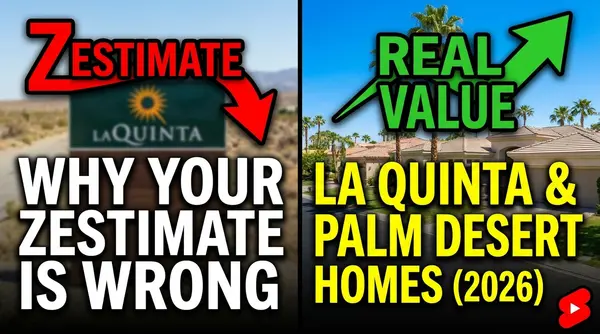
The report found that the number one thing consumers wanted AI to help with was pricing confidence, cited by 31% of respondents. Just knowing if it’s a fair price. But an AI-generated price estimate on your Coachella Valley property is working from general comparables without accounting for condition, specific street, HOA, recent local absorption rate, and a dozen other variables that move the number meaningfully. I’ve seen Zillow estimates on desert properties swing $100,000 in either direction from where a properly prepared CMA lands.
That gap between what AI says and what your specific situation actually calls for is where an experienced local agent earns their keep.
The finding I keep coming back to
42% of consumers who did not use AI during their transaction said the reason was that they trusted their agent.
Not “I don’t know how to use AI.” Not “I tried it and it wasn’t helpful.” They trusted their agent enough that they didn’t feel the need to independently verify.
That’s still where this ends up. AI changes how informed clients arrive. It raises the bar for agents who coast on vague expertise claims. It rewards agents who publish, who show their work, who are findable and characterizable before anyone picks up the phone.
But it doesn’t replace the thing that makes clients actually commit: the confidence that comes from working with someone who knows this market, knows your situation, and isn’t going to steer you wrong.
If you’ve been using AI to research the Coachella Valley and you want to compare notes on what it told you versus what I’m seeing on the ground right now, I’m genuinely happy to have that conversation.
Laura Lake | Desert Real Estate Partners
760-464-8138 | Laura@drepcv.com | DesertRealEstatePartners.com
DRE #01455311
Categories
Recent Posts


GET MORE INFORMATION