
Short-Term Rental Rules in the Coachella Valley: A City-by-City Guide
I get some version of this question almost every week, usually from a coastal owner who inherited a desert property, or a buyer eyeing a place near El Paseo and wondering if it can pay for itself on Airbnb. The honest answer is that it depends entirely on the address. Nine cities share this valley, and every one of them regulates short-term rentals differently. Some are wide open. Some have shut the door completely. A few sit somewhere in between, with rules that shift every year or two.
Below is where things stand as of August 2026, city by city, pulled directly from each city's current ordinance or official planning page rather than secondhand summaries. I have also flagged where a rule changed recently, because in this valley, "recently" can mean six months ago.
One thing to keep in mind before any of this: none of it matters if the HOA says no. I cover that at the end, and it is worth reading even if you already know the city rules cold.
Palm Springs
Palm Springs remains the most workable city in the valley for a licensed vacation rental, but it is not a free-for-all.
To operate, you need a city vacation rental permit and a Local Contact who is reachable twenty-four hours a day and able to respond in person within thirty minutes of a complaint. Annual registration fees apply and are set on the city's fee schedule, so confirm the current amount with the city rather than relying on a fixed number, since it is adjusted periodically.
The contract cap is where I see the most out-of-date information floating around. A 2022 ordinance had scheduled the cap for older, "legacy" permits (issued before November 2022) to drop from 36 contracts a year to 26, effective January 1, 2026. On October 23, 2025, the City Council canceled that scheduled cut. Legacy permits still get 36 contracts annually, plus up to 4 more in the third quarter. Permits issued after November 2022 are capped at 26 contracts a year. A Junior Certificate option allows 6 contracts a year and is not subject to the neighborhood density cap described below.
Palm Springs also caps vacation rental certificates at 20 percent of residential units within a given neighborhood. Several popular neighborhoods are already at that ceiling, which means a new application there gets returned or placed on a waitlist rather than approved outright. The city updates its neighborhood percentage table weekly, so I check it fresh for any client seriously considering an STR purchase there.
La Quinta
La Quinta has had a permanent ban on new General and Primary vacation rental permits since 2021, and that ban has not been lifted.
There are two narrow paths in. As of January 2024, a Homeshare permit is available, but it requires the owner to occupy the property throughout the guest's stay, which rules out the classic absentee-owner model. Also as of January 2024, parcels of 25,000 square feet or larger can apply for an exception, though it requires City Council approval at a public hearing rather than a routine staff sign-off. Outside of those two paths, and outside whatever legacy-exempt areas the city still maintains a list of, new STR permits in La Quinta are not happening right now.
If STR income is central to your offer strategy in La Quinta, verify the specific parcel's status with the city before you write, not after you close.
Rancho Mirage
Rancho Mirage is the simplest city to explain because the answer is no. Since July 1, 2022, short-term rentals of any kind are prohibited citywide. The minimum rental term is 28 consecutive days, and the ordinance is written broadly enough to prohibit even advertising a shorter stay, whether or not a booking ever happens.
Penalties start at $5,000 for a first citation and rise to $10,000 for repeat violations, and the city can cite the owner, the property manager, and the occupants simultaneously. There is no permit pathway around this. If a listing description in Rancho Mirage mentions short-term rental potential, that claim does not hold up.
Palm Desert
Palm Desert regulates by zone, and this is one where I would slow down and read the fine print before assuming anything.
STRs are allowed in RE (Residential Estate), R3 (multi-family), HPR (Hillside Planned Residential), and PR (Planned Residential) zones, plus the Downtown Edge Overlay with staff confirmation. In R1 and R2 zones, the standard STR use is prohibited entirely, though an On-Site Owner permit (the owner living in the home while renting out rooms) is still possible there. For HPR and PR properties, the city requires a current, dated HOA approval letter confirming short-term rentals are permitted, renewed annually alongside the permit itself.
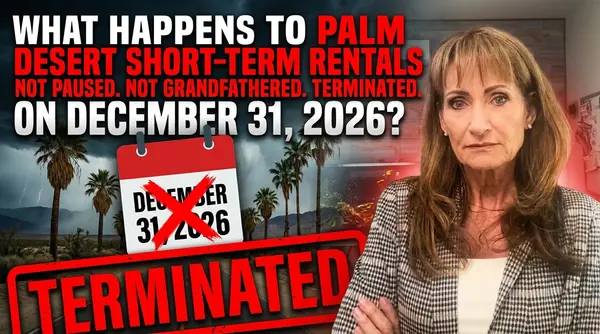
Here is the deadline worth circling on a calendar: under Palm Desert Municipal Code Section 5.10.080(B), existing off-site short-term rental permits in the HPR zone terminate permanently on December 31, 2026, and cannot be renewed. If you are looking at a hillside property in Palm Desert marketed with STR income as part of the pitch, and that permit falls in this off-site HPR category, that income has an expiration date a few months from now. I would want documentation of exactly which permit category the property holds before treating STR revenue as part of the numbers.
Cathedral City
Cathedral City has been phasing out standard vacation rentals since an ordinance took effect on October 9, 2020. New General permits are not being issued in most residential areas.
Two paths remain open. A Homeshare permit is available where the owner maintains the property as their sole residence and is present during the stay. Separately, properties within an HOA that explicitly permits short-term rentals in its governing documents can still qualify, even in a neighborhood where standalone STRs would otherwise be phased out. Short-term rentals here are also subject to the city's transient occupancy tax, commonly cited around 12 percent, though I would confirm the exact current rate with the city's finance department before running numbers, since municipal tax rates are adjusted more often than most people expect.
Indio
Indio is one of the more STR-friendly cities in the valley on paper, but the HOA layer trips up more buyers here than the city rules do.
The city issues a combined business license and STR permit, currently priced at $1,633 annually, plus a 1 percent Tourism Business Improvement District (TBID) assessment on gross rental revenue and standard transient occupancy tax. What the city permit does not tell you is whether your specific community allows it. A meaningful number of Indio HOAs prohibit rentals under 30 days in their CC&Rs regardless of what the city allows. Indian Palms Country Club and Resort is a good example of a community where some sub-associations permit vacation rentals and others do not, so a blanket assumption about "Indian Palms" as a whole is not reliable. Get the specific sub-HOA's rental policy in writing.
Indian Wells
This is the city most often described inaccurately, so I want to be precise about it. Indian Wells has not simply stopped issuing STR permits. What changed is the minimum stay: a new short-term rental license now carries a 29-night minimum for most of the year, which functionally takes it out of true short-term territory. There is one carve-out, a 7-night minimum during the BNP Paribas tennis tournament window, running one week before through three days after the tournament.
Separately, older grandfathered permits from a 2015 sign-up period have now permanently expired. So the practical picture in Indian Wells is: no true nightly or weekly rental business here anymore, tournament season aside, and the legacy exceptions that used to soften that are gone. If a listing agent tells you a specific Indian Wells property has an active traditional STR permit, ask to see it, because the general rule has closed that door.
Desert Hot Springs
Desert Hot Springs allows STRs under a citywide numeric cap, and that cap did the math for me: with roughly 9,201 total housing parcels citywide as of 2025, the 4 percent ceiling works out to 368 permitted vacation rental units total. Once the city issues that many permits in a given year, the application window closes for new applicants until it reopens.
The separation rule changed recently and in the opposite direction from what a lot of older articles still say. As of February 19, 2026, the citywide minimum distance between two permitted STR properties was reduced from 500 feet to 250 feet, which opens up more eligible parcels. Three neighborhoods kept the stricter 500-foot spacing because of documented concentration issues: Rolling Hills, DHS 41, and Hacienda Heights. The same February 2026 update also added a mandatory city-certified training requirement for owners and their agents before a permit is issued, and permits remain non-transferable, meaning a sale terminates the existing permit and the new owner starts over.
City of Coachella
Coachella runs the most streamlined permitting process in the valley and markets itself that way. A business license and an active STR permit are required before a property can be advertised or rented, and the city has eliminated mandatory pre-permit inspections that some other cities still require.
The city's own current guidance states a 14 percent transient occupancy tax on short-term rentals (an older FAQ still floating around cites 13 percent, so use 14 percent as the current figure and confirm at booking time if it matters to your numbers). Reporting is monthly, even in months with zero bookings, and payment is online only, by card or ACH. Revenue here is heavily tied to the festival calendar. April, covering both Coachella and Stagecoach weekends, is by far the strongest month, with summer months dropping off substantially. If you are underwriting a Coachella-area STR purchase, build the pro forma around that seasonality rather than an average monthly number, or the numbers will mislead you.
Bermuda Dunes and Other Unincorporated Areas
Bermuda Dunes is not its own city. It falls under unincorporated Riverside County, which means county rules apply rather than any of the municipal ordinances above.
A county STR Certificate is required, separate from a Transient Occupancy Tax Certificate, and neither transfers with a sale. A new owner has to reapply from scratch. Current fees are $740 for the initial application and $540 for annual renewal. The minimum stay is 2 consecutive nights, and quiet hours run from 10 p.m. to 7 a.m. under County Ordinance 847.
Here is the part I would flag for anyone buying in Bermuda Dunes or another unincorporated pocket of the valley right now: the county Board of Supervisors has advanced a stricter rule package covering roughly 1,100 unincorporated STR properties, including Bermuda Dunes and Thousand Palms, with a final vote scheduled for August 25, 2026. The changes on the table include eliminating the current one-hour grace period before enforcement kicks in on a violation, higher initial application fees, tougher penalties for repeat offenders, and expanded code enforcement hours. The same package would lift standing moratoriums on new certificates in B-Bar-H Ranch and Thousand Palms. If you are closing on an unincorporated-area property this fall, this vote is worth watching, since it lands right in the middle of most escrow timelines.
The Layer That Overrides Everything: Your HOA
City permission is necessary, but it is not sufficient. Most HOAs in the Coachella Valley prohibit rentals under 30 days in their CC&Rs, regardless of what the city allows. A city permit does not override an HOA restriction, and an HOA that allows short-term rentals is genuinely the exception rather than the rule here.
Palm Desert bakes this into its permit process directly, requiring a current, dated HOA approval letter for HPR and PR zone permits. Cathedral City does something similar for its HOA exception path. But even in cities that do not require the letter as part of the application, the HOA's own governing documents still control what actually happens if a homeowner tries to rent short-term without checking first.
One more thing worth knowing if STR income matters to your financing: some lenders treat heavily short-term-rented properties differently than a standard second home, which can mean a non-conventional loan, a larger down payment, or a different rate. That is a conversation to have with your lender early, not something to discover during underwriting.
What I Actually Tell Clients
The right question is never "is short-term rental legal in the Coachella Valley." It is "is short-term rental legal at this specific address, under this specific HOA, today." Those are two different questions with two different answers, and the gap between them is where I see buyers get surprised after closing rather than before.
If STR income is part of why you are looking at a property here, whether you are a coastal owner weighing a hands-off desert investment or a buyer running the numbers on a flip-and-hold, I would rather verify the permit status, the zoning, and the HOA language before an offer goes in than after. That is a five-minute conversation that can save a very expensive mistake.
Clients before compensation. No pressure, ever.
Laura Lake Your Desert Real Estate Partner LPT Realty, DRE #01455311 760-464-8138 | Laura@drepcv.com | DesertRealEstatePartners.com
Categories
Recent Posts



GET MORE INFORMATION